
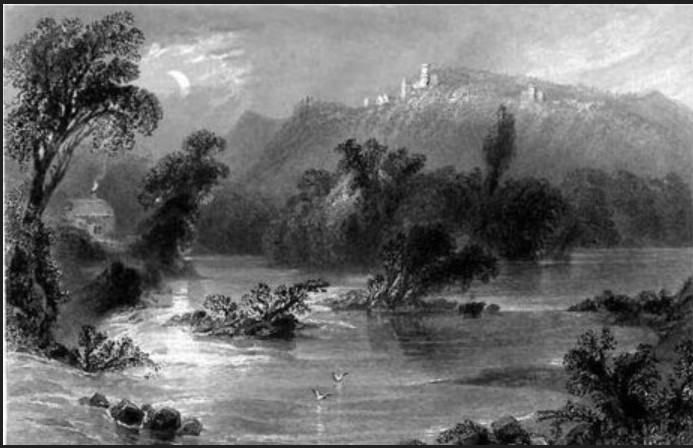
Drawn by William Henry Bartlett and engraved by J.C. Bentley.
My dad who was from Wicklow, once told me in Liverpool that one of his favourite places in Ireland was ‘The Meeting of the Waters.’ Since my dad rarely spoke of Ireland, this was memorable, and certainly the phrase ‘meeting of the waters’ has its own imagery.
In 1983, on a visit to Ireland, I went, with others whose names I no longer remember, to a bar- I think it might have been a hotel- but a car headed out along the dark country roads from Wicklow town to the Avoca valley. So, late in the evening, half drunk from the evening’s revelry, in the half light of the night, I sat and listened to the rushing water.
Vinny and Ronan, two characters in my novel ‘Across The Water’, make the same journey but in daylight.
For twenty minutes Vinny drove through the thickening country. The trees were greener, the hills were higher, and the road twisted through the rolling landscape. The windscreen was spotted with the memory of rain that came and went in flickers.
‘Have we got five minutes for me to show you something?’ Ronan asked.
‘Sure.’
‘Just a bit further now, and we’re at the meetings there’s a pub, restaurant, and garden. If you pull over, I can show you.’
‘The what?’
‘Meeting of the waters.’
Vinny pulled into a car park opposite the large stone building on the riverbank. As soon as they stepped out of the car, the sound of rushing waters surrounded them.
‘Follow me.’ Ronan led the way.
The air was fresh; a light breeze carried the remains of the rain. The sun appeared lazily between clouds. They walked through the public area with wet empty picnic tables and benches to the edge of the river. In an almost perfect Y, the rivers Avonmore and Avonbeg met to form the Avoca.
A stone-paved area formed a triangle, allowing them to stand in the middle, a river flowing each side and meeting in front of them. The effect was powerful, the rivers fast-flowing and deep, the bodies of water churned as they merged, the flow increased in strength as the Avoca rushed away down the valley.
‘You can see the line of ripples there, where the waters meet,’ Ronan pointed.
There was something urgent, demanding in the waterway, nothing could hold it back, or divert it.
‘My grandfather brought me here, told me that the rivers are our lives, those rushing waters, full of power and force, but it goes past so quickly it’s gone before we know the power we had.’
‘I can see where you get your songs from, your grandfather sounds like a character.’
‘He was, I didn’t really know him. My mam fell out with him and moved across to England. I was born there, we lived in London for a few years before she decided to give it a go back here.’
‘ English and Irish, the meeting of the waters,’ said Vinny.
‘You know I should make a song out of that… the two rivers, the two peoples?’
Vinny thought for a minute. ‘But you’re forgetting the wall.’
‘What wall? There’s no wall in these rivers.’
‘They’ve always made sure there was a wall between English and Irish.’
‘Ah, now you’re spoiling the image,’ said Ronan, he paused before adding, ‘it doesn’t last long, does it? Romanticism like, as soon as we get poetic, real-life kicks in.’
The ‘meetings’ has long been a source of romanticism and nearby the waters where Thomas Moore sat in 1807 is a stone bust and memorial to the celebrated poet;
There is not in the wide world a valley so sweet
As that vale in whose bosom the bright waters meet;
Oh! the last rays of feeling and life must depart,
Ere the bloom of that valley shall fade from my heart.
Yet it was not that nature had shed o’er the scene
Her purest of crystal and brightest of green;
‘Twas not her soft magic of streamlet or hill,
Oh! no, — it was something more exquisite still.
‘Twas that friends, the beloved of my bosom, were near,
Who made every dear scene of enchantment more dear,
And who felt how the best charms of nature improve,
When we see them reflected from looks that we love.
Sweet vale of Avoca! how calm could I rest
In thy bosom of shade, with the friends I love best,
Where the storms that we feel in this cold world should cease,
And our hearts, like thy waters, be mingled in peace.
The vale of Avoca is often presented as part of the ‘Garden of Ireland’. It is a beautiful valley, with stunning traditional villages, so pretty that Avoca was chosen as the location for the long running TV drama ‘Ballykissangel’. In many ways the valley encompasses the duality of Ireland embodying the romantic and the reality.
James Joyce’s Leopold Bloom in Ulysses also pierces the poet’s pastoral idyll. Noting the location of a Thomas Moore statue in Dublin that happened to be close to a public toilet he can’t help but take the piss.
‘He crossed under Tommy Moore’s roguish finger. They did right to put him up over a urinal: meeting of the waters.’
I’m not sure why my dad mentioned the ‘Meetings’ but a look into our family history might provide the reason. My dad was brought up on Strand street in Wicklow, his father Benjamin who died in Speke Liverpool, was also raised in the same street, that street leads onto the quays of Wicklow Harbour. It was from the quays of Wicklow harbour that my family went to sea and thus through Garston docks in Liverpool, But that journey may well have started high up in the Avoca valley.
The reality of life in the Avoca valley would have been pretty harsh. Strange though it might seem that one of Ireland’s most beautiful valleys might also be the centre of industrial operations. Mining operations had been in Avoca for as long as humans carved out a living there. Tin, copper, and lead were among the metals mined. In later years, pyrites and sulphur were the mainstay, employing up to a couple of thousand people on the hillsides. The mines employed beam steam engines adapted from the tin mines in Cornwall. Various mines operated right up to 1982, although all the mines are now closed, some of the original engine houses and chimneys remain.
By 1874 the mining industry had passed its peak, new mineral sources that provided greater scale and so lower costs and higher profits came on stream in the 1870s from Spain and Australia.
But not much stranger than the Avoca gold rush, almost exactly one hundred years before the marriage ceremony in Avoca church. On 15th September 1795 gold was discovered by workmen when clearing a mountainside, digging up a tree to find a large gold nugget in its roots. Given the size of the nugget those workmen stopped clearing trees and began to pan the local waterway, the Ballinvally or Aughatinavought. Which became known as Gold Mines River. Within days word had spread and hundreds and then thousands of men from around the region descended on the valley, and finds were made, it is estimated that up to 80kg of gold was fished out of the river banks and pools.
Merchants, traders, speculators and gold buyers flocked to the area, pop up inns with beer and whiskey followed, at the high point it is calculated that 4000 men were camping or commuting to the valley on a daily basis. Groups of men were formed, to work and defend their claims, the whole scene grew incredibly quickly so much so, that within a month the army were sent in to close the whole thing down. This was done for two reasons, first to claim whatever gold could be mined for the Crown, and secondly to contain what had become a maelstrom. Remember this was just four years before the uprising of the United Irishmen in 1798.
I am always conscious of the impact of Ireland’s colonisation by England. The Agorta Mor or great hunger from 1845 on, devastated the island. Even Wicklow county and the Avoca valley which suffered less than most of the country, because it relied less on large landed estates, and small tenant plots, and had industries such as mining and fisheries, lost twenty five percent of its population. The Wicklow workhouses in Rathdrum and Shillelagh were bursting at the seams during those years and turning starving people away, Rathdrum built for 600 held 1,300 at this time while Shillelagh meant to house 200 had over 400.
Besides the tourists and poets, who knows how many people have sat beside ‘The Meetings’ and found solace or despair in those rushing waters, while lives and history just like the waters ran its course.


Leave a Reply