
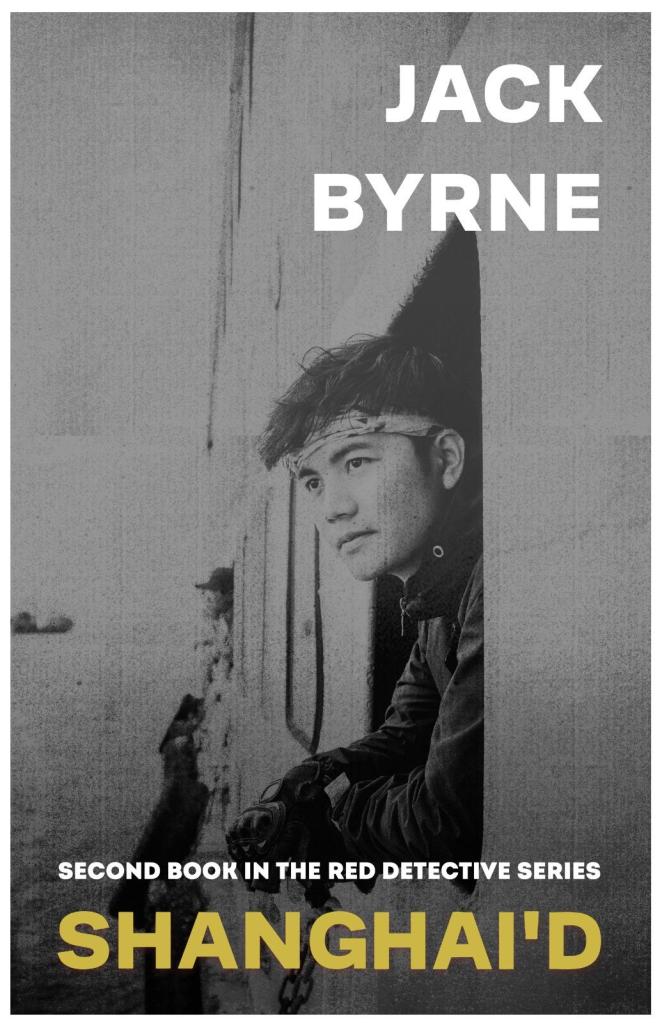
The first time I heard of the expulsion of hundreds of Chinese Seamen from Liverpool following WW2, I knew I wanted to write about it. My novel Shanghai’d will be published by Northodox Press this week, it is a story that spans generations and continents as we follow families who to this day search for loved ones and the truth.
Under The Bridge, Across The Water and Before The Storm, the three books that make up the Liverpool Mystery series, follow a migrant from Ireland travelling to Liverpool following WW2. My father made that trip; the books were not about my family, but families like mine. Set next to Garston docks, dealing with union struggles, police corruption, and gangs, the mysteries offer, a realistic picture of Liverpool Life.
Liverpool life today and throughout history has always dealt with the consequences of Empire. From the earliest days when King John in 1207 established the city as a Royal Port to launch his invasion of Ireland. Through the years of the slave trade, and the exodus of the An Gorta Mor or Irish Famine years that saw hundreds of thousands of Irish not only travel through but settle in the city. The port that looks out through the Mersey estuary to the world built a maritime trade that encompassed the globe. Alfred Holt and Company, more commonly known as the Blue Funnel Line, was one of the first to use coal-powered steamships to drastically reduce sailing times to the Far East. Chinese Sailors, together with Lascars, Sierra Leonians, and many others, as a consequence, became a common sight in communities close to the docks. The Nook pub in Nelson St became a social base for Chinese sailors.
Donna Maria Brunero of the National University of Singapore commented on an early draft of Shanghai’d.
‘The shift between the three timelines/eras works really well. I was glad to find the sections on the 1940s as this gave the ‘lost’ men and their families a chance to tell some of their story. It is a really nice touch.’
The three timelines are the 1940s, the events of Toxteth in 1981, and the 2010s. What happens in the 1940s becomes the catalyst for danger, attacks, and mystery in L8 and the city in the following decades.
Recruitment of Chinese seafarers was heightened during WW2, despite at first being on less wages and receiving no war risk payments, thousands ran the gauntlet of the Battle of the Atlantic. During these years, many met and married local women; many of these women were from the Irish community. In preparation for this novel, I was lucky enough to be able to talk to Peter Foo and Philip Sze, two Liverpool men whose childhood was blighted by the loss of their father. In sweeps across the boarding houses, cafes and social clubs,or by administrative means refusing to sanction shore leave, and forced signing on, innocent men were deported, leaving families not only fatherless but penniless without a breadwinner. Groups of relatives, the celebrated campaigner Yvonne Foley and MP Kim Johnson among them, have uncovered documents that prove this crime was approved at the highest level of the British establishment.
My own Irish grandfather was a merchant seaman who died in the English Channel supporting the D-Day landings. My 14-year-old mother and her siblings suffered his loss in the post-war years, but at least they knew how and why their father was lost. For wives and children of the Chinese seamen, there was only absence, no information, no support, an abandonment forced by the British state.
There have been documentaries on these events, there is a plaque at the Pier Head, and a historic and commemorative walk is being prepared. For me, as part of an immigrant seafaring family, this is a Liverpool story, one that should be made known to all Scousers. We are from a city that was both built and scarred by the experience of Empire. My novels are mysteries, and in most there is a body, or a ‘whodunnit’ element to turn the pages, in Shanghai’d as one character explains.
“The fact that there is no body doesn’t mean there wasn’t a crime. The crime is the destruction of hundreds of families, in the name of shipping companies’ profit, enforced by the police and immigration service, justified by racism, and all of it hidden by successive governments. That’s the crime.”
The reality of Empire for many in the UK today is coming to terms with its demise, and understanding that us immigrants are ‘here’ because the Empire was there. For the families of the Chinese seaman, ‘I am here’ resonates with knowledge that their fathers were not.
For The Liverpool Mysteries Irish diaspora novels
For Shanghai’d and the Red detective novels.


Leave a comment