
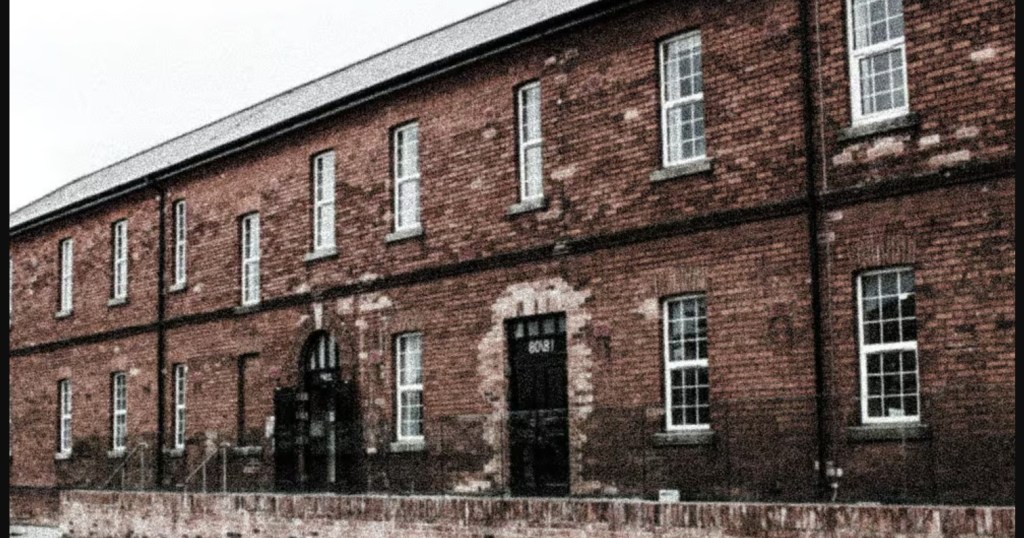
Ebrington Barracks, Derry City, Ireland.
I first contacted Mountjoy Jail in Dublin in 2021. My dad who served time in Mountjoy Jail before he left Ireland, died in 2011, so ten years had passed between his death and my attempted resurrection of the facts of his life.
The emails with Bernadette from irishprisons.ie ran their course with no result. She could find no trace of my dad. Two years later, Bernadette is no longer at irishprisons.ie. Gmail informed me that her email doesn’t exist anymore. So, armed with the correct date of birth for my dad, I started again.
I also contacted gov.uk to get my brother’s Military records. If this seems like a spurt of activity from me, it is. I’ve always had an ambivalent relationship with the information surrounding my family, or family records, it goes like this: ‘I know what I experienced and saw, and finding out dates and places for things I’m not aware of, will make no difference.’
There are two other influences in this. The first is understanding that my family was poor and that generally, the lives of poor people are much less recorded and documented than those with money. Unless that is, they cross or breach the system in some way, become a rebel or a criminal, then they will have police and prison records, maybe court hearings, even newspaper reports. But a typical working guy or woman will have their birth, death, and marriage recorded and not much in between unless they have kids.
My dad was poor, he told me they had nothing, and I’m sure I remember him telling me that the house in Strand St, Wicklow, had a dirt floor. Dirt floor equals dirt poor in my understanding, so I didn’t think there was much to discover anyway.
The second influence in this disregard for the facts of family life, was its insignificance in our upbringing. I never knew my mum or dad’s birthdate until I was an adult. If you assume that their birthdays were never celebrated, you would be right.
I have no memory of my mum or dad celebrating, and I didn’t know any of my siblings’ dates of birth either. Even now, at a ripe old age, I had to ask my sister for my dad’s and brothers’ dates of birth to initiate the process of getting records.
There is one incident in my childhood that drove home this lack of regard for officialdom. I brought home paperwork from St Christopher’s.
I can’t remember what the document was. Maybe it was permission to do something or other. Anyway, this document recorded my birthdate as the 22nd of November.
My mum looked at it, pulled a puzzled face, and said, ‘You were born on the 16th.’ She shrugged and then said, ‘Someone must have told them the 22nd. Never mind, it won’t make any difference.’
It did make a difference, though. The wrong official birthday followed me throughout my school days. I was always conscious that if I gave my D.O.B. to a teacher, I should give the ‘official one,’ not the real one. So, from my earliest days, I imbued the idea that the real us may not be the version recorded, if it was recorded at all.
A second and more tragic version of this duality dominated our lives for decades. Getting my older brother Peter’s military records is an act of closure on the difficult process of coming to terms with his death. There are so many aspects to this it’s difficult to get them in order.
The first benevolent lie was told by my oldest sister, no doubt as an act of kindness, with or without my parents’ knowledge; I have no idea.
A chippy tea was not unknown, but in the middle of the week, it was a bit odd. I got home from school around 5pm, on the 14 November 1975. You will note from above my birthday was the 16th, just two days away, although, to be fair, I wasn’t conscious of it at the time.
As I entered the back kitchen, I saw lots of chippy papers on the table. It was just two steps from the back door through the kitchen to the living room door. I knew something was different when my oldest sister opened the living room door, and I saw a flash of uncles and aunts. I thought I saw my mum but couldn’t be sure, the room was packed and dimly lit, the curtains were closed, and the overhead light wasn’t on.
There were murmurs and some head movement, and thinking back, I don’t know if I heard or imagined cries. Yvonne, my sister, was out quickly, and the door into that secret world of grief was closed and wouldn’t be opened again for many years.
“There’s fish cake and chips for your tea.” She pointed at the pile.
I dropped my bag and dug in. Having found my portion and opened it up, I asked, ‘What’s going on?’
Yvonne was a strong young woman; she would have been around twenty at the time. She worked in Thomson and Capper a local chemical factory. “Peter’s had an accident.”
Peter was my nineteen-year-old brother who had been in the army for a couple of years. He had been posted to the Far East, Hong Kong, and Kowloon, and our house bore the evidence. A large woven rug with a stag covered the back wall of the living room. Peter had brought it back on one of his few visits home. He seemed happy and loved his exotic army life.
I remember the first indication I had that maybe army life wasn’t all sunshine and faraway places. Peter showed us photos of riot training. Troops with shields and batons faced off against other troops in civvies playing at riot. I don’t know if this training was in preparation for Ireland, but it was the first time that violence entered the picture for me.
Fingers already greasy with chips, I asked. ‘What kind of accident?’
‘He’s dead.’
Even though it seemed to fit the definition of ‘no sugarcoating it,’ it turned out to be completely sugarcoated.
‘He was getting out of his jeep, and the rifles are stored behind them. He was getting it out, and it went off and killed him.’ Yvonne delivered the lines clearly and without emotion.
She left me in the back kitchen alone with the news of my brother’s death. The chips were suddenly less enticing. Peter had transferred from the exotic Hong Kong to the terraced streets of Derry in Northern Ireland.
Now, I wonder who invented that story. I doubt it was Yvonne. I don’t think it would have been my parents; they would have been too distraught at the shocking news of their son’s death by suicide. It was probably an aunt or an uncle, maybe even Uncle Jim, who I’d never met but later learnt that during WW2 he was in the military police. There is a follow-up story I might get around to. About how Jim thought his military experience might carry some weight, but he landed in Derry and was unceremoniously told, ‘To fuck off ‘ by the army, ‘ before you get hurt.’ All this aside, to my two days short of fifteen-year-old self, the accident story was sad but plausible.
This is the second duality. Between the real and official and is a more profound and lasting one. Although this time the official was real, and the story the world around us heard was false. Peter had committed suicide. I found this out for sure decades later.
I applied for and got the coroner’s report into his death. In the early 1990s, I visited all my siblings with the coroner’s report to make sure they knew the truth.
The weird thing was, even after I got the inquest verdict, with witness statements and details, I didn’t know if my mum and dad knew it was suicide. Was the truth hidden from them? Or just us children, or was it just the younger children?
So, at the time, my younger sister and I, and the outside world were told his death was accidental…but then was it?
I sat in the kitchen, absorbing this news with cold chips as best I could.
Yvonne reappeared and announced, ‘You are going to Carol’s.’
Carol, the second oldest sister, lived in a flat in Netherley. I would be there until after Peter’s funeral.
Once that living room door closed on grief, it closed for good: no wake, no funeral, no discussion, no comfort or reassurance from my parents. In truth, no tears from me. There have been many since, but again, not for decades. This next piece is taken from my book of short stories, The One Road. This was in Carol’s flat, the incidents are compressed in time but real.
‘Walkways in the sky.’
Lips pursed, Harry blew out the trumpet sound of the last post. The wail of his voice was in mockery, not respect. The funeral was real; the death was real in Allerton cemetery grounds, and the trumpet and tears were real. In grieving for one of their own, uniformed boys became men. In the act of grieving their own, parents and siblings became less.
Buuur Burrr, he trumpeted to his wife’s tears.
‘How can you be so cruel?’ Karen asked.
But she knew the answer. Surrounded by uniformed youth in the company of real men, Harry was diminished. He knew it, and she knew it. His bravado and cruelty were in place of strength.
‘It’s not fair,’ said Carl, watching his sister cry. He feared what was coming but didn’t know how to stop it.
“Those fucking bastards, they are nothing. Did you see them strutting around in their uniforms? I could have had any of them one-to-one. The hardest in Halewood I was, no one messed with our family.”
They were not in Halewood, where he was from. They were not in Speke, where Karen was from. They were in Netherley, where people lived, but no one was from.
Built on the Eastern edge of Liverpool, that was how they lived–on the edge. A planner’s paradise and a tenant’s nightmare. Tomorrow’s living today. Prefabricated concrete panels in a new system of construction. Living by design, thousands of people moved out of the city centre in slum clearances, now trapped in damp-ridden, vermin-infested concrete boxes four or five storeys high. High-level walkways and connecting bridges between blocks.
When the first slap hit Karen, she stifled her cries. Carl knew she was trying to hide her pain and fear, nothing could hide the anger and cruelty in Harry.
“Leave her alone,” Carl pleaded, too scared to shout or demand.
“Shut up, or you’ll get it as well.”
“Go in the bedroom, look after Sharon,” said Karen.
Sharon was Carl’s niece, barely walking and sleeping now. Carl knew Karen was sending him away to protect him.
Harry stood and crossed the room. He leaned over Karen, who curled into a ball. Carl knew what was coming. Karen cried in fear.
Harry boomed in anger, “All of them, I could have had all of them.”
Carl said, “Karen, I’m going to phone Mum.”
Karen looked up and shouted, “No.”
Harry punched. Carl saw it hit. He felt the blow on his sister’s face.
The tears poured from his eyes. Tears of anger and frustration. I’m phoning. He choked and fled.
He ran through the concrete walkways, his feet pounding out his hatred. A phone, a phone. Through the tunnelled high-level connecting bridges, down the rancid urine-stained staircase, and across the shit-covered grass, he found a phone. He had no money to phone, his mum had no phone to answer.
Carl stood and cried as he waited. How long do we wait till we know it’s over? When do we admit we have made mistakes?
Built in 1968, demolished fifteen years later, the flats were turned to rubble and dust. The planners won prizes and moved on. Lessons of tomorrow’s design learned today.
Karen and Harry divorced, Carl and Sharon grew, and everyone was battered and bruised by walkways in the sky.
The one element missing from above is the real life ‘Harry’ dropping hints that the death was no accident but suicide.
Sent away by parents to avoid the trauma of a funeral, the result was the trauma of the closed door on grief, with the additional suspicion of suicide as a birthday present.


Leave a Reply