
On a flying visit to Ireland recently, I went to the South West, New Ross and Enniscorthy.
I was there looking for a house, so like it or not, I was also part of the conversation about the current housing crisis in Ireland. With the government removing the ban on evictions, on April 1st 2023 there is heightened tension around the question. The housing crisis in the UK and Ireland stem from a reliance on private developers to solve a social question. The right to safe secure housing should be guaranteed in our society. Housing like many other social services has fallen foul of the ‘privatisation’ mantra.
The ‘right to buy’ in the UK led to the depletion of social housing stock, as individual tenants bought houses at massive discounts, and then wholesale transfers of housing stock to Housing Associations and private contractors. While many older people have gained in this transfer of capital and assets. It has left younger generations unable to buy and struggling to pay rent. It must be also said that reliance on the housing market for pensions and wealth is a risky business, as the crash in 2008 proved.
Ireland in the early 2000s saw a slew of tax benefits and buy to let schemes and a reliance by the government on the private rental sector. In essence what existed as social capital, housing stock, available for working class tenants, has become private capital owned by an ageing landlord class and a raft of private developers. Despite boom and busts of property speculation there has been no significant return to a policy of building council houses and home ownership becomes a distant hope for many younger people.
But back in New Ross, my own search for accommodation that night was to be in vain. Above the no vacancies sign at the Inishross House B&B was a plaque marking the visit of James Connolly to the town in 1912. He was on a recruitment drive for the Transport and General Workers Union. Back then, Connolly was clear on the solution to the lack of sanitary, safe, affordable housing. In an issue of Workers Republic he explained;
…there were two allied measures which, were they applied, might do much to at once relieve the most odious and directly pressing evils arising from the congested state of our cities. Those two measures were:–
- Taxation of unlet houses,
and
- Erection at public expense of Artisans’ Dwellings, to be let at a rent covering cost of construction and maintenance alone.
Put simply these two measures alone would go a long way to reversing the growth of the scourge homelessness in the UK and Ireland.
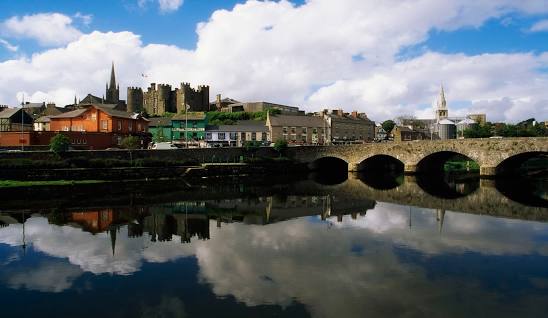
The river Slaney runs through this town lauded by James Joyce, and home town of author Colm Toibin. Enniscorthy is a beautiful place with a castle, cathedral and two bridges crossing the fast flowing river. I looked at two properties here, both on the same side of the river and was surpised to find both were occupied by renters. Interestingly the adverts didn’t acknowledge the houses had sitting tenants and when I mentioned this to the agent. He explained that they were coming to the end of their tenancy. He assured me they would be ‘happy to leave’. The houses were halfway up a hill, but hills and Eniscorthy go together in history.
Vinegar hill one side of the valley was the site of a famous defeat for the United Irishmen in the rebellion of 1798. The pitched battle between the rebels and the much better armed government forces saw losses of up to 1,200 on the rebel side. Wherever I have been in Ireland there are memorials to those who fought in 1798, 1916 or the war of independence.
Before I left town another conflict was brought to my attention over the hills of Enniscorthy. More recent and thankfully much less deadly, asking for directions I was told a certain address was on the far side of the river. The kindly and elderly lady who gave me this information also added that in the old days they weren’t allowed over there.
‘Why not?’ I asked.
“They were the ‘far siders’ we didn’t mix with the far siders.”
“The far siders?” I asked.
“Yes, they lived on the far side of the river, we were always in competition with them, we didn’t mix.”
After a brief pause, “oh I see they were far siders- because they lived on the far side of the river?”
“Yes that’s right.” She seemed pleased I’d cottoned on.
I took another pause before asking, “If you called them the far siders. What did they call you?
Without missing a beat she replied “The far siders, of course.”
I got my directions and went down the hill and across the bridge, where a paving stoned is inscribed with the legend.
‘If you are in Enniscorthy, you are at the top of a hill, at the bottom of a hill, going up a hill or going down a hill.’
During my brief visit I managed to to do all of those. My hope is that Ireland and the UK return to building tens of thousands of solid council houses for the tens of thousands desperate for affordable homes, in the process defeating the far right claims that ‘asylum seekers’ contribute to the lack of affordable housing.
I will be back in Ireland for The Town of Books https://graiguenamanaghtownofbooks.ie/ in Graiguenamangh Kilkenny at the end of next week. The whole town is taken over by booksellers, every nook and cranny converted for the purpose. Thousands of browsers make the trip over the course of the weekend. I will be there to try and meet as many of the 25 independent bookshops as I can, sell a few books and have a few pints. Wish me luck.
Connolly quote from
From The Workers’ Republic, 18 November 1899.
Reprinted in Red Banner, No.18.
Transcribed by Aindrias Ó Cathasaigh.
Marked up by Einde O’Callaghan for the Marxists’ Internet Archive.


 Jack Byrne
Leave a reply to Lisa Cancel reply